Bitcoin mining is the process that secures the Bitcoin network, confirms transactions, and introduces new bitcoins into circulation. It replaces centralized authorities with cryptography, economic incentives, and distributed consensus.
What Is Bitcoin Mining?
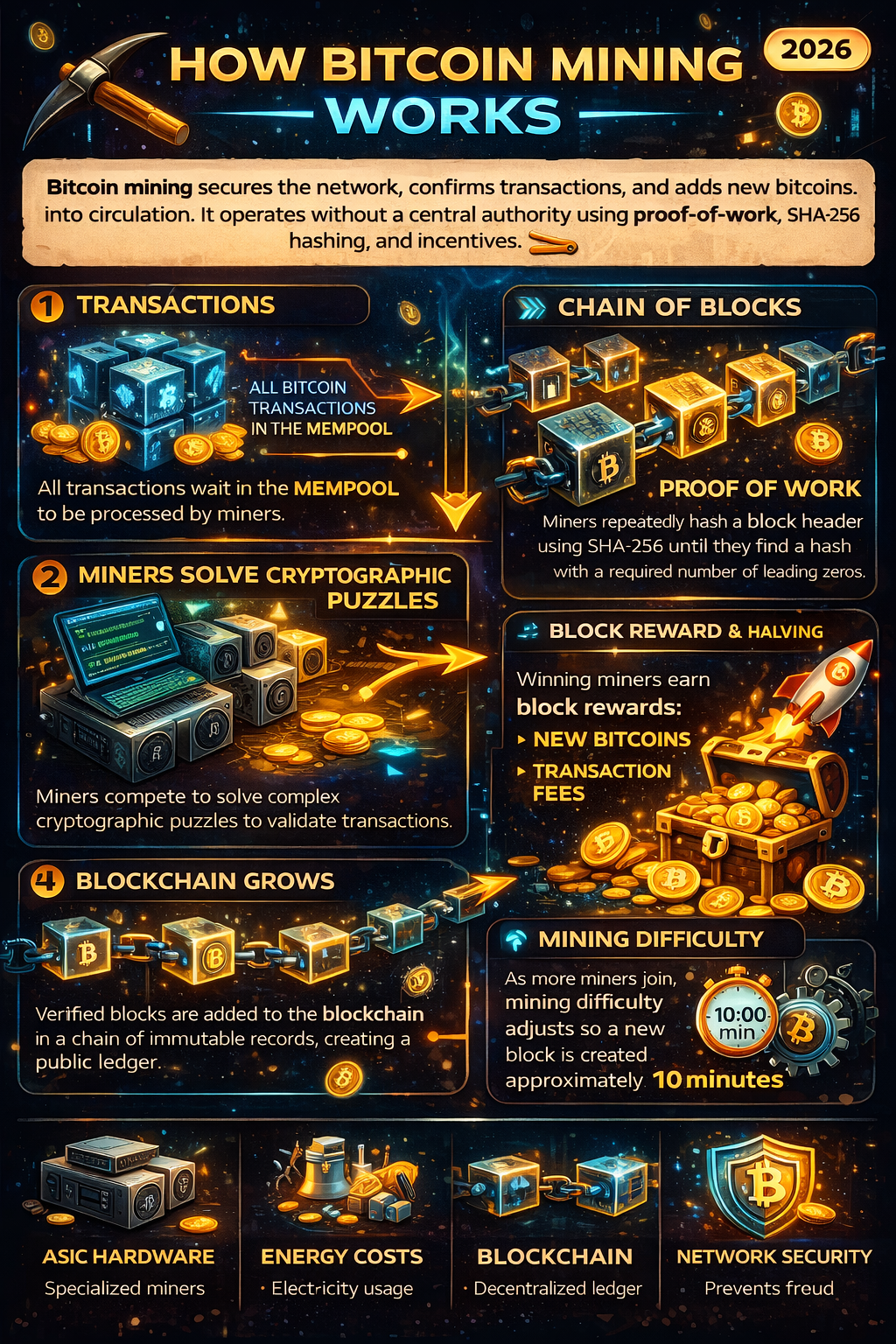
Bitcoin mining is the act of validating transactions and adding them to the public Bitcoin blockchain. Miners compete to solve cryptographic puzzles, and the first miner to find a valid solution earns the right to add a new block.
Proof of Work Explained
Bitcoin uses a consensus mechanism known as Proof of Work. Miners must perform real computational work by hashing block data until the result meets strict network difficulty rules. This work is difficult to perform but easy for the network to verify.
SHA-256 Hashing
Mining relies on the SHA-256 cryptographic hash function. Miners repeatedly change a value called a nonce and hash the block header until the output is below the required target. Even small changes produce entirely different hash results.
Difficulty Adjustment and Block Timing
Bitcoin targets one new block every 10 minutes. Every 2016 blocks (roughly two weeks), the network automatically adjusts mining difficulty to keep block times stable.
Block Rewards and Halving
When a miner successfully mines a block, they receive:
- Newly created bitcoins (block subsidy)
- Transaction fees from included transactions
Approximately every four years, Bitcoin undergoes a halving, reducing the block subsidy by 50%. This enforces Bitcoin’s fixed maximum supply of 21 million coins.
Mining Hardware
Modern Bitcoin mining is performed using specialized hardware called ASICs (Application-Specific Integrated Circuits), which are designed exclusively for SHA-256 hashing. These machines are far more efficient than CPUs or GPUs.
Energy Use and Security
Proof of Work consumes energy because it anchors Bitcoin’s security in the physical world. Miners are incentivized to seek the lowest-cost energy, often using surplus, stranded, or renewable power sources. This makes attacking the network extremely expensive.
Why Bitcoin Mining Matters
- Prevents double-spending
- Secures the blockchain
- Enforces monetary policy
- Maintains decentralization
Infographic: How Bitcoin Mining Works
More Bitcoin Education
Explore more in-depth Bitcoin guides and tutorials here:
Conclusion
Bitcoin mining is the backbone of the Bitcoin network. By combining cryptography, Proof of Work, and economic incentives, mining creates a secure, censorship-resistant monetary system that operates without permission or trust.